The town
Vengerberg is a market town of about 5,800 people on the north bank of the River Pontar, where the old road over Beacon Hill came down to the river crossing.
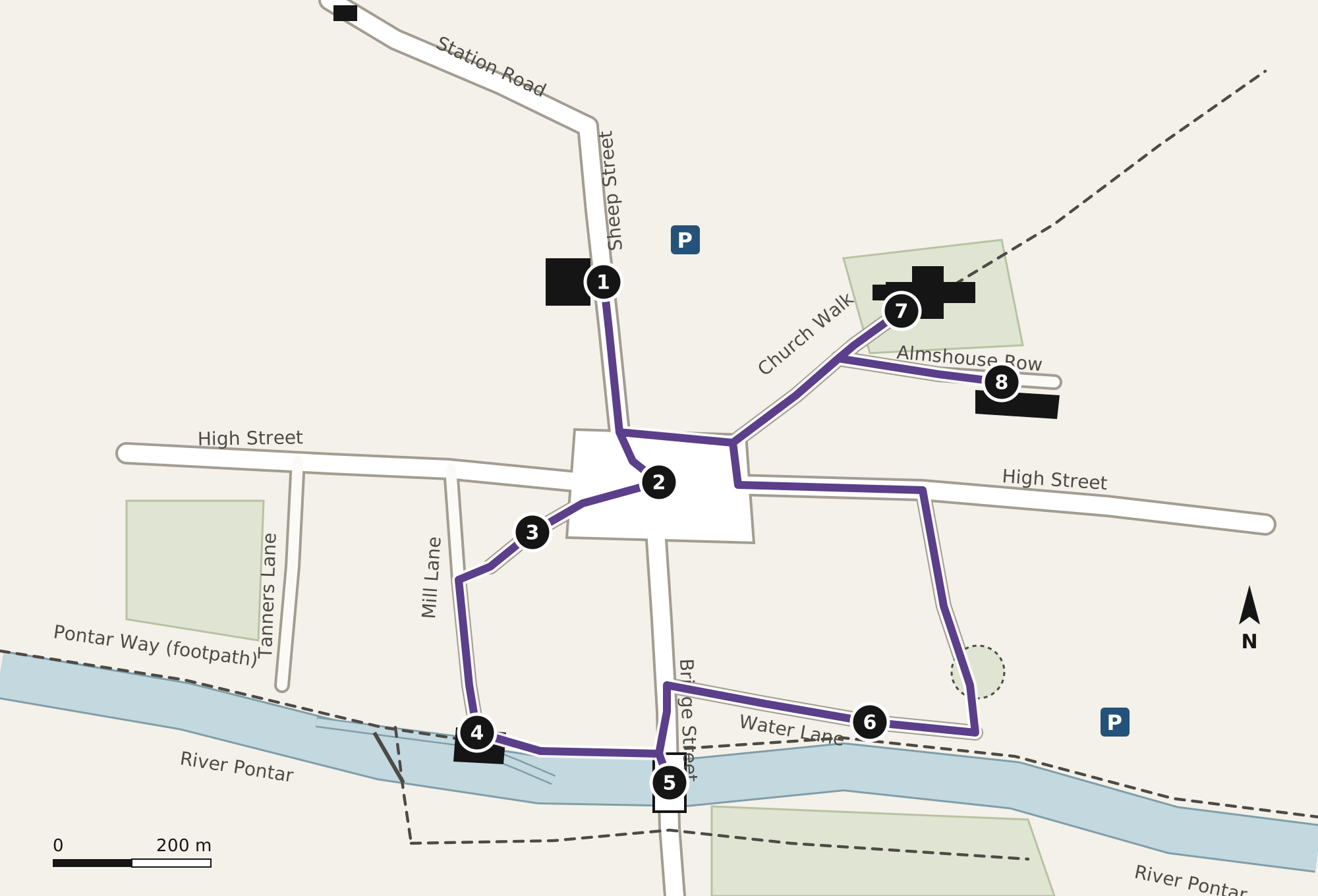
The town grew up around the Market Square, where the road from the hill met the road along the valley, and the market has been held there every Thursday since the charter of 1252. Most of the buildings round the square and along High Street are older than their fronts: timber-framed houses of the sixteenth and seventeenth centuries refronted in brick in the eighteenth.
From the square, Sheep Street runs north past the Old Grammar School, where the museum is, to the station. Bridge Street runs south to the Town Bridge and the river, with the Town Mill upstream and the Town Quay below the bridge. Church Walk climbs north-east under its lilacs to St Laurence’s Church and Corbet’s Almshouses.
The statue in the Market Square, unveiled in 1898, shows the woman the town calls the Lilac Sorceress. Her legend, the lilacs and the Lilac Fair each May are the things visitors most often know the town for.
In this section
- A short history, from Domesday to the present day
- The legend of the Lilac Sorceress
- The market charter of 1252
- The town crest and the borough seal
- St Laurence’s Church and the violet window
- The statue in the Market Square
- The bridge and the river, the mill and the flood marks
The town today
Vengerberg has two primary schools, a secondary school, a library, a doctors’ surgery, a pharmacy and about sixty shops, cafés and pubs. The Thursday market has about eighteen stalls. The town council meets in the Town Hall on the Market Square, and the district council runs the car parks. For council services, please contact the councils directly; the Trust is an independent charity and cannot help with them.